Zero Trust Security for Small Business: A Practical Guide (2026)
Imagine this: you walk into a café you visit every day. The barista recognizes you, smiles, and hands you your favourite drink without checking your name on the order. It feels convenient — but what if someone just walked in behind you who wasn't you? You'd want more than familiarity; you'd want confirmation that the person picking up the coffee is actually you.
That very idea — never assume you're actually you without proof — is the heart of Zero Trust in cybersecurity. In a world where attackers can slip into networks, pretend to be real users, or lurk inside systems undetected, simply trusting anyone inside the digital perimeter isn't good enough anymore.
What Zero Trust Actually Means
Zero Trust is a cybersecurity approach built around one simple — but powerful — idea:
Never trust anything automatically — always verify.
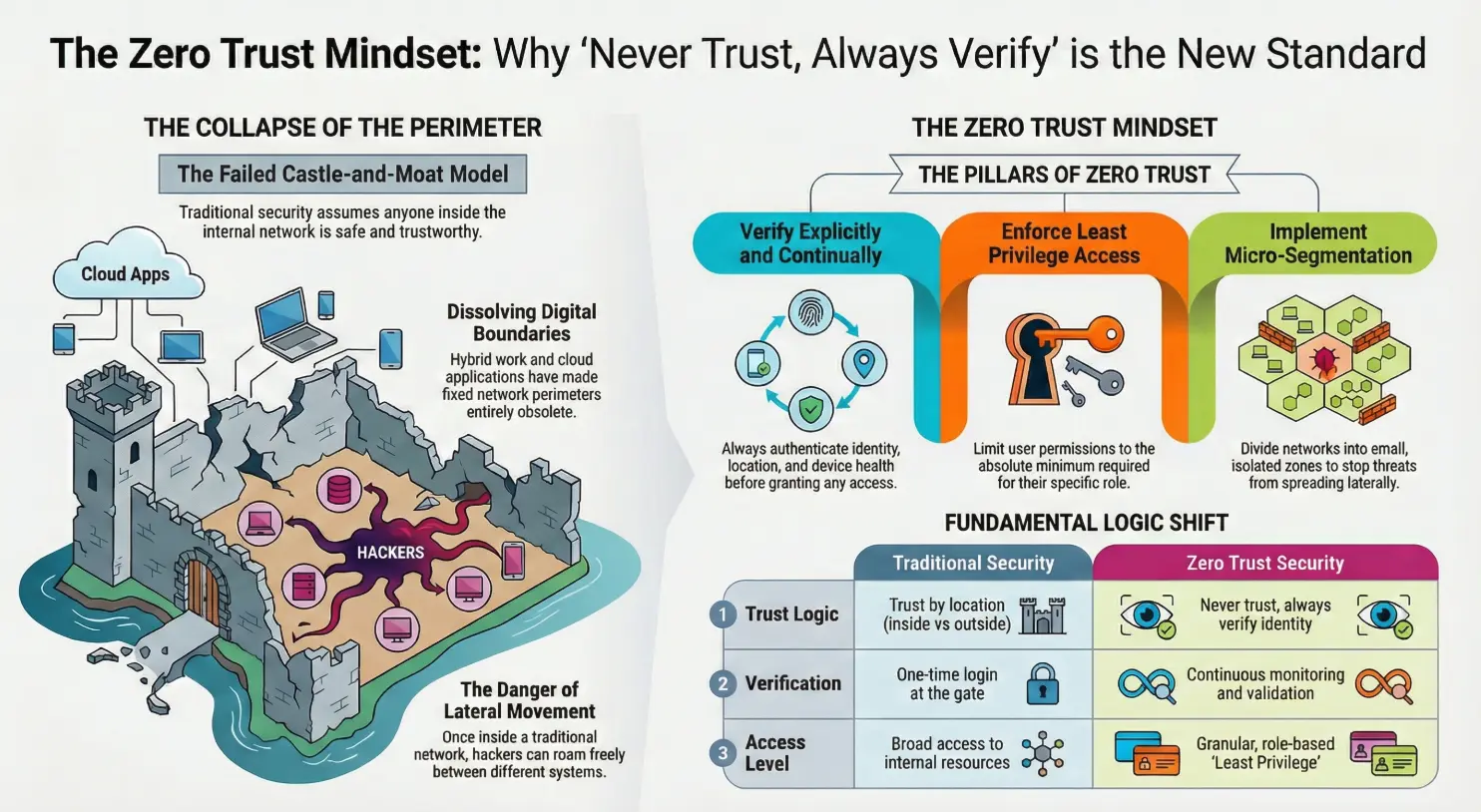
In traditional digital security, once you're "inside" a corporate network (like logging in from the office), systems often treat you as safe. Think of the castle-and-moat analogy: the firewall is the moat; once over it, you're free to roam. That's how defenders used to think. But in today's world of hybrid work, cloud apps, mobile devices, and third-party access, there isn't a clear perimeter anymore.
Zero Trust flips this old assumption on its head. Even if you're inside the network, using a known device, or have logged in before — you're not trusted automatically. Every access request must be verified before access is granted.
Why Zero Trust Is Crucial Today
Modern digital life means:
- Employees work from home, coffee shops, and airports
- Cloud applications are everywhere
- Devices connect from all kinds of locations
- A breach in a single account can spread quickly
With these changes, the castle moat doesn't exist anymore. A hacker tricking one employee into clicking a malicious link can suddenly gain access — and once inside, can explore freely unless protections stop them. Zero Trust stops that lateral movement by verifying every request, every time.
Another way to think about it is airport security. You don't just get screened once at the main entrance and then roam the terminal unchecked — every zone, whether lounge, gate, or restricted area, checks your ID. That's Zero Trust in action.
Zero Trust in Everyday Life: A Simple Metaphor
1. Your front door lock vs. your safe:
Your house lock keeps most people out, but once inside, everything is accessible. A safe inside the house adds another layer. Zero Trust says every time you want something from the safe, ask for identity confirmation — even if the person is already inside the house.
2. Online banking:
You log in with a password, then the bank asks for a one-time code sent to your phone. Even if someone stole your password, without that code they're blocked. That's Zero Trust in action — verifying before access.
How You Can Start Implementing Zero Trust
- Verify Explicitly
- Least Privilege Access
- Micro-Segmentation
- Continuous Monitoring and Validation
- Device Health Checks
This isn't "turn it on and forget it" — it's an ongoing posture shift to assume the network is always hostile until proven safe.
Real-World Example: Zero Trust in Action
Let's say your company file server contains sensitive customer data. Under the old model:
- You log into the company network
- You can access everything immediately
Under Zero Trust:
- You log in with MFA
- Your device's security posture is checked
- Your access request to the file server is validated
- You get only the permissions necessary
If any step fails — access is refused. It's like having multiple locks on a vault, not just the front door.
Zero Trust Isn't Magic — It's a Mindset
Zero Trust isn't just a checklist of tools — it's a shift in how you think about digital security. It acknowledges that threats can come from within and outside, and that access should never be assumed safe.
This approach aligns with modern realities: hybrid work, cloud services, mobile devices, and an explosion of remote access points all make perimeter walls obsolete.
Take the Next Step Toward Smarter Security
Understanding Zero Trust can feel like learning a new language at first, but it's one of the most effective defences today's organisations have against breaches, ransomware, and insider threats.
At Andi-Tech, we help businesses of all sizes design and implement Zero Trust strategies — from identity authentication and MFA to micro-segmentation and continuous monitoring. Explore our cybersecurity solutions to see how we can protect your business.
📧 Ready to implement Zero Trust in your business?
Drop us a line at info@andi-tech.com — let's make your systems safer, smarter, and ready for the challenges of tomorrow.