Understanding the OSI Model: A Simple Guide for Everyone
Have you ever wondered how your message, email, or video call travels across the internet? Behind the scenes, there's a system that makes all communication possible: the OSI Model.
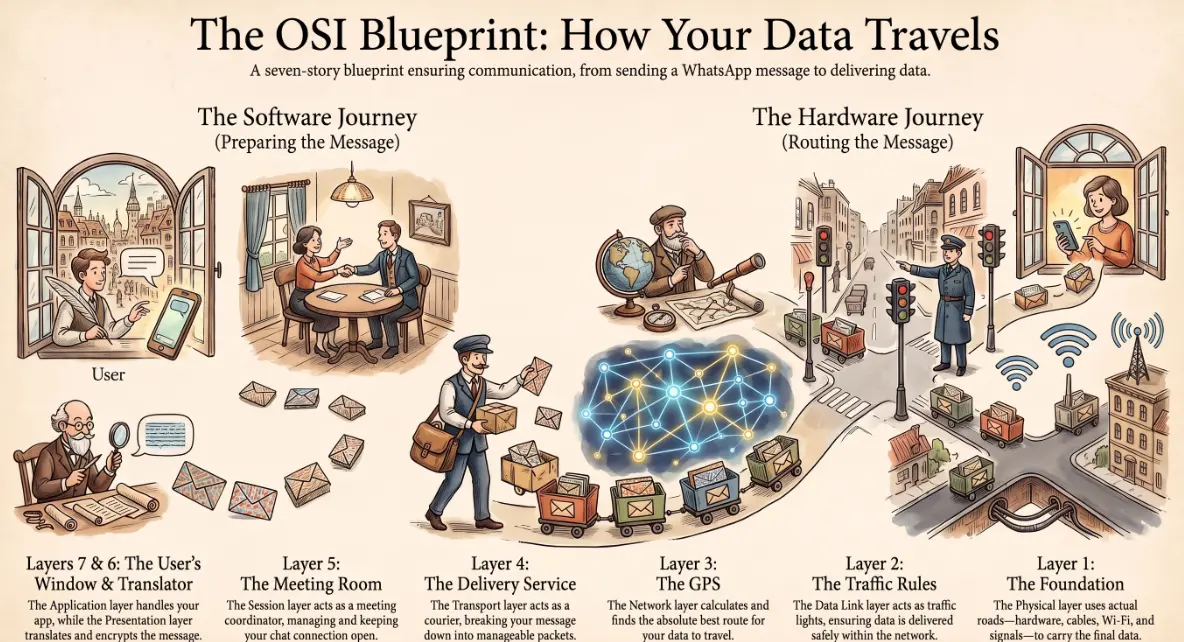
The OSI (Open Systems Interconnection) model is like a blueprint for how computers and devices talk to each other. Think of it as a seven-story building, where each floor has its own job. Together, all floors make sure your information goes from one device to another reliably.
The 7 Layers of the OSI Model (Made Simple)
- Physical Layer — The Foundation
Deals with hardware: cables, Wi-Fi, switches, and signals. Like the roads that carry cars. - Data Link Layer — The Traffic Rules
Makes sure data is delivered safely within the same network. Like traffic lights and signs. - Network Layer — The GPS
Finds the best route for data to travel across networks. Like Google Maps for your data. - Transport Layer — The Delivery Service
Breaks information into smaller packets and ensures it arrives correctly. Like a courier service. - Session Layer — The Meeting Room
Manages connections between devices. Like a meeting coordinator. - Presentation Layer — The Translator
Converts data into readable format (encryption, compression). Like a translator between languages. - Application Layer — The User's Window
The apps and services we see: email, web browsers, video calls. Like the front door of communication.
Why Should You Care?
- Understand why your internet might not be working
- Communicate better with IT support — you'll know exactly which layer the problem is at
- Appreciate the invisible teamwork that makes the internet function
Real-Life Example: Sending a WhatsApp Message
Here's what happens in milliseconds when you send a message:
- Application layer handles the WhatsApp app
- Presentation layer encrypts your message
- Session layer keeps your chat connection open
- Transport layer breaks the message into packets
- Network layer routes it to your friend's phone
- Data Link and Physical layers handle the Wi-Fi or mobile signal
Key Takeaway
The OSI model may sound technical, but it's simply a step-by-step system that ensures your data gets where it needs to go — securely and reliably. Understanding it helps you diagnose problems faster and communicate more clearly with your IT team. If your business needs network support or infrastructure help, our 24/7 service desk is always available.
📩 Need IT help or have a networking question?
At Andi-Tech, we make complex IT concepts simple and keep your business infrastructure running smoothly.
Contact us at info@andi-tech.com — we're happy to help.