Managed IT services vs in-house IT for small business
A small business owner in Dublin hired her first full-time IT person two years ago. The salary was £45,000. Add employer National Insurance, pension contributions, a laptop, training budget, and the Microsoft certifications she needed him to hold — and the real cost was closer to £62,000 annually. He was excellent. He worked Monday to Friday, 9 to 5. He knew Windows, Microsoft 365, and the office network well. He had no background in cybersecurity, no experience with Azure, and no cover when he took two weeks off in August. On a Saturday night in October, a ransomware attack started spreading through the file server. Nobody noticed until Monday morning.
That is not a criticism of the IT hire. It is a structural problem that no single person can solve.
What in-house IT really costs when you account for everything
The salary figure is the visible cost. The full picture is considerably higher. For a business in the US or UK hiring a competent mid-level IT generalist, the loaded cost typically includes:
- 💷 Base salary — £40,000–£65,000 in the UK; $55,000–$90,000 in the US depending on location and experience
- 📋 Employer taxes and benefits — typically 20–30% on top of salary (National Insurance, pension, healthcare, paid leave)
- 🖥️ Equipment and licensing — laptop, software tools, endpoint management licensing, monitoring tools
- 🎓 Training and certifications — Microsoft certifications alone run $300–$500 per exam; maintaining relevance in a fast-moving field requires continuous investment
- 🔍 Recruitment costs — agency fees of 15–20% of first-year salary are standard; a bad hire costs considerably more
- ⏳ Opportunity cost of vacancy — the average IT role takes 6–10 weeks to fill; your environment is either unmanaged or covered by expensive contractors in the meantime
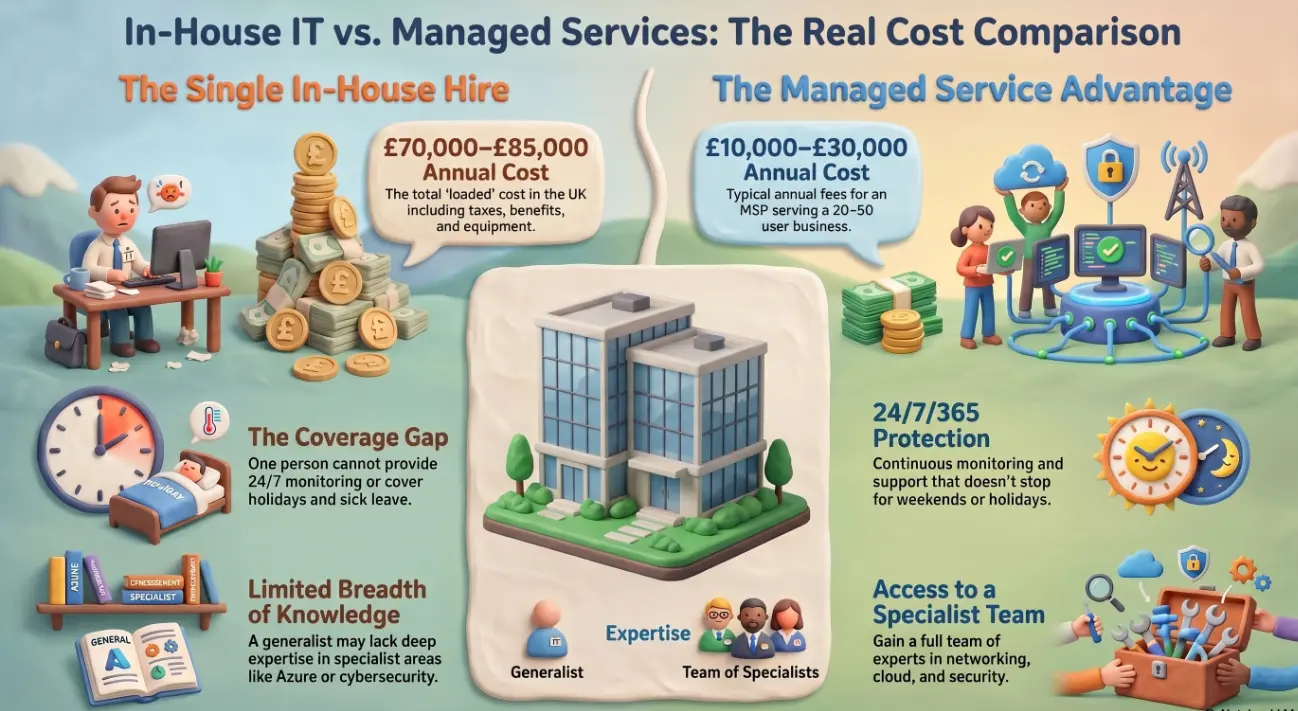
For a business with 20–50 employees, a realistic all-in cost for one IT person is £70,000–£85,000 per year in the UK, or $95,000–$120,000 in the US. That is before you consider what that person cannot cover.
What managed IT services include — and what is usually out of scope
A managed service provider (MSP) typically delivers a defined scope of services for a fixed monthly fee. For a business of 20–50 users, this commonly includes:
- 24/7 monitoring of servers, endpoints, and network infrastructure
- Helpdesk support — remote and sometimes on-site — during agreed hours
- Patch management and software updates across the device fleet
- Backup monitoring and verification
- Antivirus and endpoint security management
- Microsoft 365 administration — user provisioning, licence management, mailbox support
What is typically out of scope or priced additionally: major infrastructure projects, new site builds, advanced cybersecurity services (penetration testing, SIEM, SOC), custom software development, and hardware procurement.
The monthly cost for a 20–50 user business from a reputable MSP typically runs £800–£2,500 per month in the UK, or $1,200–$4,000 in the US — depending on scope, headcount, and complexity. Annualised, that is £10,000–£30,000 against a comparable in-house cost of £70,000–£85,000.
The coverage gap — why one IT person can never fully protect a business
The structural problem with a single in-house IT hire is not competence. It is bandwidth and breadth.
A competent IT generalist knows a wide range of things to a medium depth. Modern business IT requires deep expertise across networking, cloud infrastructure, Microsoft 365 administration, cybersecurity, compliance, and end-user support — simultaneously. No single person holds all of that at a high level, and no single person is available around the clock.
Consider what happens in practice:
- 🌙 Out-of-hours incidents — ransomware, server failures, and account compromises do not respect working hours. A solo IT hire has no on-call obligation unless explicitly contracted, and most don't.
- 🏖️ Holiday and sick cover — a business with one IT person has zero IT coverage whenever that person is absent, unless it pays for contractors.
- 🔐 Specialist domains — if your IT generalist was hired for helpdesk and network support, they are unlikely to be the right person to configure Conditional Access policies, respond to a security incident, or migrate your infrastructure to Azure.
An MSP brings a team. When one engineer is occupied or unavailable, another picks up. Specialist knowledge — security, cloud architecture, compliance — is accessible without hiring for it.
When in-house IT makes sense and when it does not
In-house IT makes genuine sense in specific circumstances:
- Your business has 100+ users and complex, bespoke infrastructure that requires deep institutional knowledge
- You operate in a regulated environment where an embedded IT person is required for compliance or audit purposes
- You have already committed to an MSP relationship and want an internal liaison or IT manager to oversee it
For businesses under 50–75 users, a full-time IT hire rarely makes financial or operational sense against a well-scoped MSP engagement. The cost is higher, the coverage is narrower, and the risk of a single point of failure is real.
For businesses between 75–150 users, the calculus becomes genuinely contextual — depending on the complexity of the environment, the availability of local IT talent, and the nature of the work.
The hybrid model — using an MSP to augment an existing internal team
The binary framing of "in-house vs outsourced" misses a model that many growing businesses use effectively: a lean internal IT presence supported by an MSP for specialist coverage, out-of-hours monitoring, and capacity overflow.
In practice, this looks like:
- An internal IT coordinator or manager who handles day-to-day user requests, asset management, and vendor relationships
- An MSP providing 24/7 monitoring, security management, cloud administration, and escalation support for issues that exceed the internal team's scope
- Clear demarcation of responsibilities so neither party is duplicating effort or leaving gaps
This model gives businesses the institutional knowledge and physical presence of an internal hire, without the coverage gaps and specialist limitations that come with a solo IT role.
For most SMBs evaluating the make-or-buy decision, the honest answer is that Andi-Tech's IT services will cost less, cover more, and carry less operational risk than a comparable in-house hire — and a free cost comparison conversation is the fastest way to test that claim against your specific numbers.
💼 Wondering whether an MSP or an in-house hire is the right call for your business?
Andi-Tech offers a free cost comparison consultation — we'll put our managed IT pricing against the real cost of an equivalent in-house hire for your headcount and environment, so you can make the decision with actual numbers.
Contact us at info@andi-tech.com
— let's run the numbers together and find the model that actually fits your business.