What Is the Dark Web? Business Risks & How to Protect Your Company
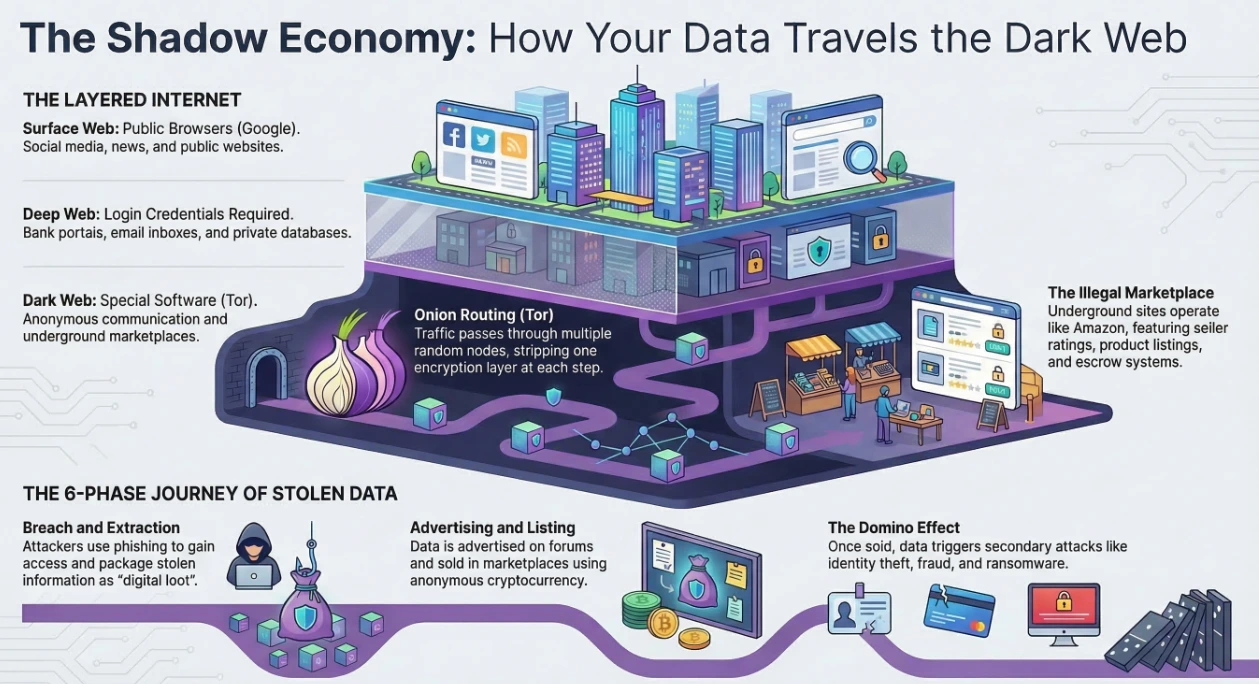
Imagine the internet as a massive city.
Most people live in the bright downtown area — Google, YouTube, LinkedIn, news sites. This visible part is called the Surface Web.
Then there are private buildings — bank portals, corporate databases, email inboxes. They exist online but require login credentials. That layer is the Deep Web.
And finally… there are hidden underground tunnels beneath the city.
That's the Dark Web.
What Is the Dark Web?
The Dark Web is a small part of the internet that cannot be accessed through normal browsers or search engines. It requires special software and networks designed to hide users and websites.
Unlike regular websites:
- Google cannot index it
- URLs look strange (often ending in .onion)
- Identities and locations are hidden
Think of it like a hidden neighbourhood that doesn't appear on city maps.
Important truth:
The dark web itself is not illegal. It was originally created to provide privacy and anonymity for journalists, activists, and people living under censorship.
But as with any hidden place, some people use it for darker activities.
What Is Tor?
To enter this hidden internet, you usually need a special browser called Tor (The Onion Router).
Why "Onion"? Because it hides information in multiple layers of encryption.
Here is the simplified journey:
- Your request enters the Tor network
- It travels through several random computers (nodes)
- Each step removes one encryption layer
- The final destination receives the request but cannot trace where it started
Imagine sending a secret letter inside three sealed envelopes, each delivered by a different courier. No single courier knows both who sent the message and where it finally goes. That's Tor's magic.
Why Hackers Use the Dark Web
Anonymity changes behaviour. Hackers use the dark web because it provides:
- 🔒 Hidden identities
- 🌍 Global reach
- 💰 Cryptocurrency payments
- 🛡️ Harder law-enforcement tracking
Inside these networks, criminals trade things like:
- Stolen passwords
- Hacked company databases
- Ransomware tools
- Phishing kits
- Compromised email accounts
In fact, billions of stolen credentials circulate on dark-web forums and markets. The dark web becomes a meeting place for cybercrime economies.
What Is a Dark Web Marketplace?
Now imagine an Amazon-style website… but for illegal goods. That's essentially a dark web marketplace.
These marketplaces operate through Tor and allow anonymous buyers and sellers to trade items like:
- Stolen credit card data
- Login credentials
- Hacking tools
- Fake passports
- Malware kits
They even work like real e-commerce platforms:
- ⭐ Seller ratings
- 💬 Vendor reviews
- 🛒 Product listings
- 🔐 Escrow payment systems
A famous early example was Silk Road, launched in 2011, which allowed anonymous trading using Bitcoin before authorities shut it down. Yes — the underground economy can look surprisingly organised.
The Journey of Stolen Data: From Hack to Dark Web Sale
Now let's follow a story. Meet Alex, an employee in a company who accidentally clicks a phishing email. From that moment, a chain reaction begins.
Phase 1 — The Initial Breach
Attackers trick users using:
- Phishing emails
- Malicious attachments
- Fake login pages
Once the victim clicks, malware may steal credentials or open a backdoor.
Phase 2 — Data Extraction
Hackers explore the compromised system and collect valuable information:
- Email credentials
- Customer databases
- Credit card numbers
- Internal documents
The data is packaged like digital loot.
Phase 3 — Data Packaging
Cybercriminals organise stolen information into categories:
- Financial records
- Corporate credentials
- Identity documents
- Healthcare records
This makes the data easier to sell.
Phase 4 — Advertising on Dark Web Forums
Next, hackers move to underground forums. Posts may look like:
"500K corporate emails from finance company — fresh breach — escrow accepted."
These forums act like classified ads for cybercrime.
Phase 5 — Marketplace Listing
The hacker uploads the dataset to a marketplace. Buyers browse listings similar to online shopping:
- Description of stolen data
- Number of records
- Price in cryptocurrency
- Seller reputation
Payments are usually made with Bitcoin or Monero for anonymity.
Phase 6 — The Data Gets Used
Once sold, the data may be used for:
- Identity theft
- Fraud
- Business espionage
- Ransomware attacks
- Further phishing campaigns
A single breach can trigger thousands of new attacks — like dominoes falling in a cybercrime chain.
The Real Lesson Behind the Dark Web
The dark web itself isn't the villain. It's simply technology designed for anonymity. Some people use it to protect free speech. Others misuse it for crime. Technology is neutral — human choices decide how it's used.
How to Protect Your Business from Dark Web Threats
Cybersecurity isn't just about firewalls and antivirus software. It starts with awareness. The next time you see a suspicious email, an unusual login request, or a strange link:
- 🛑 Pause — don't click immediately
- 🔍 Verify — check the sender and URL
- 📢 Report it — tell your IT team
A single report can prevent an entire breach. Explore our cybersecurity solutions to see how Andi-Tech can help protect your business from dark web threats and data breaches.
📧 Contact us at info@andi-tech.com — together we can make the digital world a little safer, one smart click at a time.